
18/06/2025
A todos nos ha pasado: esa sensación de tener los ojos a medio cerrar, la mente un poco nublada, pero sin estar completamente dormidos. Es ese estado intermedio entre la vigilia y el sueño profundo que en español describimos a menudo como estar 'medio dormido'. Pero, ¿cómo traducimos esa sensación tan específica al inglés? No siempre es una traducción literal, y el inglés, al igual que el español, ofrece diversas formas de expresar los distintos matices del cansancio y la somnolencia.
Cuando aprendemos un nuevo idioma, es crucial ir más allá de las traducciones palabra por palabra y comprender las expresiones idiomáticas y el vocabulario preciso para cada situación. El caso de 'medio dormido' es un ejemplo perfecto de por qué esta sutileza es tan importante para sonar más natural y comunicar exactamente lo que queremos decir.
Más Allá de 'Sleeping': El Espectro de la Somnolencia
Pensamos en dormir como un estado binario: o estás despierto o estás dormido. Sin embargo, la realidad es mucho más compleja. Hay un espectro que va desde estar ligeramente cansado, pasando por tener sueño, estar adormecido, hasta finalmente caer en un sueño profundo. En español, tenemos palabras como 'cansado', 'con sueño', 'adormilado', 'amodorrado', 'aletargado', 'traspuesto', 'semidormido' y, por supuesto, 'medio dormido'. Cada una describe un punto diferente en este continuo.
El inglés también tiene un vocabulario rico para describir estas etapas. Conocer estas palabras te permitirá expresar tu estado con mucha mayor precisión. No es lo mismo decir 'I'm tired' (Estoy cansado) que 'I'm sleepy' (Tengo sueño), o 'I'm half asleep' (Estoy medio dormido).
'Medio Dormido': Encontrando el Equivalente en Inglés
La frase 'medio dormido' describe ese estado de transición o de sueño ligero donde la persona no está completamente consciente, pero tampoco está en un sueño profundo. Como vimos en el ejemplo de Drácula, 'semidormido' es un sinónimo válido en español, y el asistente estaba en ese estado cuando escuchó las voces.
En inglés, la traducción más directa y común para 'medio dormido' es precisamente half asleep. Esta frase se utiliza exactamente para describir a alguien que está en ese estado de duermevela, a punto de dormirse o recién despertado, pero aún no completamente alerta. Por ejemplo, 'He was half asleep when the phone rang' (Estaba medio dormido cuando sonó el teléfono).
Otra palabra muy útil y frecuente es drowsy. Esta palabra se refiere a sentirse somnoliento, a tener una fuerte necesidad de dormir, lo que a menudo lleva a ese estado de 'medio dormido'. Es un término más general para describir la sensación de estar adormecido o amodorrado. 'The medication made me feel drowsy' (La medicina me hizo sentir somnoliento/amodorrado).
Términos como 'amodorrado', 'aletargado' y 'traspuesto' que se mencionan en la información proporcionada también tienen equivalentes en inglés que capturan diferentes aspectos de la somnolencia o la falta de energía. 'Drowsy' cubre bien 'amodorrado' y 'traspuesto' (en el sentido de estar adormecido). 'Aletargado' podría traducirse como 'lethargic' o 'listless', que implican una falta de energía y vitalidad, a menudo asociada al cansancio extremo o a alguna condición médica, no solo a tener sueño.
Understanding 'Half Asleep': Common Phrases and Usage
Let's focus more on 'half asleep'. This phrase paints a clear picture: you're not fully awake, nor are you fully immersed in sleep. It's a state where you might still process some external stimuli, albeit slowly and perhaps confusedly.
- Example 1: 'I tried to read, but I was so tired I kept falling half asleep.' (Intenté leer, pero estaba tan cansado que me quedaba medio dormido constantemente.)
- Example 2: 'She answered the door looking completely half asleep.' (Abrió la puerta con aspecto completamente medio dormido.)
It's a state often associated with being woken up suddenly or trying to stay awake when very tired.
Beyond 'Half Asleep': Other Ways to Express Drowsiness
While 'half asleep' is excellent for that specific state, English offers other ways to talk about feeling sleepy or the act of entering that state:
- Sleepy: This is a general term for feeling the need to sleep. 'I'm feeling sleepy' is like saying 'Tengo sueño'.
- Nodding off: This phrase describes the action of starting to fall asleep, often involuntarily, especially when sitting up. It implies the head nodding motion. 'He was so bored by the lecture, he kept nodding off.' (Estaba tan aburrido con la conferencia que no paraba de quedarse dormido/dar cabezadas.) This can often be the physical manifestation of being 'half asleep' or becoming 'drowsy'.
- Groggy: This term is often used to describe the state of being confused or semi-conscious, especially after just waking up from a deep sleep or when sick. While related to sleepiness, it emphasizes the disorientation. 'I felt groggy after taking the sleeping pill.' (Me sentí aturdido/somnoliento después de tomar la pastilla para dormir.)
- Dozing: Similar to 'nodding off', 'dozing' means sleeping lightly, often for a short period during the day. 'He was dozing in his armchair.' (Estaba durmiendo una siesta ligera/dando cabezadas en su sillón.) Someone who is dozing might be described as being 'half asleep'.
Using these different terms adds richness and precision to your English. Knowing when to use 'drowsy' versus 'half asleep' or 'nodding off' will make you sound much more like a native speaker.
'Sleeping' vs 'Asleep': Clarifying the Basics
The user's question about 'estoy durmiendo' vs 'estoy dormido' highlights a common point of confusion regarding the difference between the gerund ('-ing' form) and the past participle used as an adjective.
- Sleeping: This is the present participle (gerund when used in continuous tenses). It describes the action of sleeping. 'I am sleeping' means 'Estoy durmiendo'. It focuses on the ongoing process.
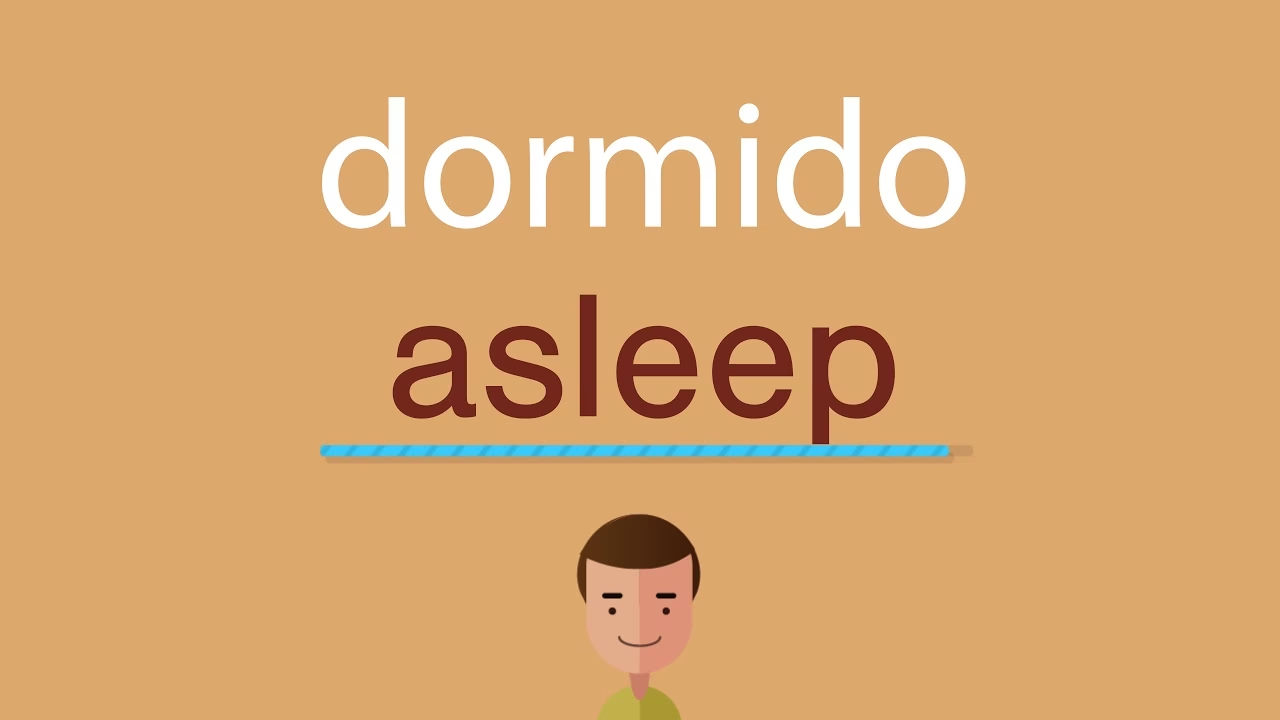
- Asleep: This is an adjective describing the state of being in a state of sleep. 'I am asleep' means 'Estoy dormido' (or 'Estoy dormida' for a female speaker). It focuses on the condition of being in sleep.
While 'I am sleeping' and 'I am asleep' can often be used interchangeably in casual conversation to mean 'I am in bed sleeping', there is a subtle difference. 'I am sleeping' sounds slightly more active, describing what you are currently doing. 'I am asleep' describes your current state. For example, if someone calls you late, you might tell them, 'I was already asleep!' (¡Ya estaba dormido/a!), referring to your state before they called. If you are describing what you are doing right now in bed, you could say 'I am sleeping'.
In many contexts, the meaning overlaps significantly, but understanding that 'sleeping' is the action and 'asleep' is the state (like 'awake' is the state of not sleeping) is key to mastering these forms.
Avoiding Confusion: The Many Meanings of 'Medio'
One reason learners might be tempted to translate 'medio dormido' literally is the common word 'medio' in Spanish. However, 'medio' is a very versatile word with multiple meanings, only one of which is 'half'. The context completely changes its translation.
Let's look at some examples provided in the source text to illustrate this point:
| Frase en Español | Significado de 'Medio' | Traducción al Inglés | Ejemplo de Uso (Inglés) |
|---|---|---|---|
| Oriente Medio | Geografía (Middle) | Middle East | Peace in the Middle East. |
| Consumidor medio | Estadística/Típico (Average) | Average consumer | For the average consumer. |
| Por medio de | Método/Instrumento (Through, By means of) | Through, By means of | Offered through higher courts. By what method will it arrive? |
| Medio ambiente | Entorno (Environment) | Environment | Protect the environment. Likely to affect the environment. |
| A medio plazo | Tiempo (Medium-term) | Medium-term | Medium-term fiscal consolidation. |
| Medio millón | Cantidad (Half a million) | Half a million | More than half a million visits. |
| Arco de medio punto | Geometría/Arquitectura (Half) | Rounded arch (or half-point arch) | Entrances through rounded arches. |
| Valor medio aritmético | Estadística (Average) | Arithmetic average value | Respect to the arithmetic average value. |
| Medio de grabación | Soporte/Sustrato (Media) | Recording media | The recording media is not usable. |
| Medio de disuasión | Instrumento (Means) | Means | As a means of military deterrence. |
| Arco medio | ¿? (Context needed, maybe average?) | N/A (Example unclear) | N/A |
As you can see, 'medio' translates to 'Middle', 'average', 'through', 'environment', 'medium-term', 'half', 'media', or 'means', depending entirely on the context. In 'medio dormido', 'medio' functions more like an intensifier or part of a fixed expression meaning 'partially' or 'in a state between awake and asleep', rather than literally 'half' of the act of sleeping. This is why understanding collocations and fixed phrases is essential.
Why Nuance Matters in English
Having multiple ways to describe similar but distinct states – like feeling sleepy, being drowsy, or being half asleep – allows for much more precise communication. Imagine trying to explain to a doctor exactly how you're feeling if you only had one word for every state of tiredness or sleepiness. Each term carries a slightly different connotation and is appropriate in different situations.
Mastering these nuances is a mark of advanced English proficiency. It helps you express yourself more accurately and understand others more fully, whether you're discussing your health, describing a character in a story (like the assistant in Drácula), or simply explaining why you're not performing at your best ('Sorry, I'm still a bit half asleep').
Preguntas Frecuentes (FAQs)
¿Es 'half asleep' la única forma de decir 'medio dormido'?
No, 'half asleep' es muy común y directo. Sin embargo, 'drowsy' también es un excelente equivalente, especialmente para describir la sensación general de estar adormecido o amodorrado. La elección entre uno y otro puede depender del contexto y del matiz exacto que quieras expresar.
¿Cuál es la diferencia entre 'sleeping' y 'asleep'?
'Sleeping' es el gerundio y se usa para describir la acción en progreso ('I am sleeping' - Estoy durmiendo). 'Asleep' es un adjetivo que describe el estado ('I am asleep' - Estoy dormido/a). Aunque a menudo se usan de forma similar en el presente, 'asleep' es más común para hablar del estado en el pasado ('He was already asleep when I called').
¿Puedo usar 'half' con otras palabras para describir estados, como 'half tired'?
Generalmente no. 'Half asleep' es una expresión bastante establecida. No es común decir 'half tired' o 'half hungry' en el mismo sentido. Para 'medio cansado', podrías decir 'a bit tired' o 'slightly tired'. Para 'medio lleno/vacío' sí se usa 'half full/half empty', pero ese es el significado de cantidad de 'half', no el uso particular de 'half asleep'.
¿Cómo sé qué significado de 'medio' usar en español?
El significado de 'medio' en español depende completamente del contexto. Debes fijarte en la palabra o frase que acompaña. Por ejemplo, si se refiere a una parte de un todo o una cantidad, probablemente sea 'half'. Si se refiere a un método o instrumento, puede ser 'through' o 'means'. Si habla del entorno, es 'environment'. La tabla comparativa anterior muestra varios ejemplos de cómo el contexto determina la traducción.
¿Es importante aprender todas estas palabras para la somnolencia?
Sí, si quieres comunicarte con precisión en inglés. Tener un vocabulario variado te permite expresar exactamente cómo te sientes o describir situaciones con mayor detalle, lo cual es fundamental para una comunicación efectiva y para comprender textos y conversaciones más complejos.
Si quieres conocer otros artículos parecidos a Expresa Tu Sueño en Inglés: Más Allá de 'Sleeping' puedes visitar la categoría Inglés.